Walnut occupies a narrow place in interior design. It is darker than oak, warmer than grey, and tied to mid-century furniture and high-end cabinetry. Designers reach for it as the anchor tone in a room because it reads as expensive without being loud. The difficulty has never been the look. It has been the supply chain. Solid walnut is a slow-growing hardwood, veneer is thin and unforgiving in humid climates, and both demand skilled labour on site. On a project with a fixed handover date, that combination is a scheduling risk as much as a cost one. Co-extruded WPC panels move the economics without moving the visual reference: the grain is printed on a film and bonded to a composite core in a single extrusion pass, so the appearance survives while material cost and installation time both fall.
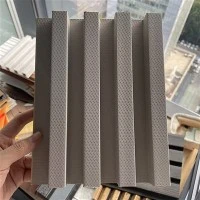
Look at the cut end of this profile and the construction is visible. A light composite core, a decorative film, and a protective top layer are formed together rather than glued together afterwards. That distinction matters more than the photograph. Because there is no adhesive line between skin and substrate, there is no delamination edge for moisture to work into - the standard failure mode of laminated MDF and of cheap film-wrapped boards in bathrooms and coastal climates. The hollow channels running through the core do a second job: they cut weight, which counts on ceilings and on large-format walls where every kilogram has to be carried up a stairwell, and they interrupt sound transmission better than a solid sheet of the same thickness. In practice that keeps a full-height wall flat without a backing frame.
The face is divided into three flat fields separated by shallow V-grooves. This is a lighting decision as much as a decorative one. A flat wall under a single downlight reads flat; the same wall with three shadow lines reads as depth, and the effect holds in an interior corridor with no daylight at all. The grooves also solve a joint problem. Because the panels interlock along the edge, the repeat is set in the factory rather than by the installer's eye, and the shadow line absorbs the small misalignment that would otherwise appear as a bright seam under raking light. For buyers comparing quotations, that is the difference between a wall that photographs well and a wall that survives a site inspection.

Installation follows the same logic. The profile is light enough for one person to handle a full length, cuts with standard woodworking tools, and fixes with adhesive on a flat substrate or with clips on a batten system. No wet trades, no drying time, no painting. A single room can be closed out in an afternoon. For a fitout contractor that is a programming gain, not a cost saving - and on a fixed handover date the two are the same thing. It is also why the format has moved from feature walls into full-room applications - wardrobes, headboards, reception desks, restaurant booths, and the long walls behind a television that every residential buyer now expects to be designed rather than painted.
One point deserves care in specification. Walnut-effect finishes vary enormously between suppliers, and the difference is rarely visible in a product photograph. Two panels can carry the same name and sit three shades apart under 3000K lighting, which is exactly the lighting most residential projects use. Ask for a physical sample, compare it against the actual floor and cabinetry on site, and confirm the batch-to-batch colour tolerance in writing before committing to a container. The other item to verify is the substrate and top layer rather than the print: request the panel's fire test report for the market you are selling into, and confirm whether the surface is a co-extruded wear layer or a laminated film, because the two behave very differently after two years of cleaning.
Walnut is not a trend that needs rescuing. It is a tone with a permanent place in premium interiors and a permanent cost problem attached to it. What has changed is that the cost problem is now optional. For distributors and fitout contractors, that is the opening: the same visual language, a fraction of the material spend, and an installation sequence that no longer depends on a specialist veneer crew being available in the right week.