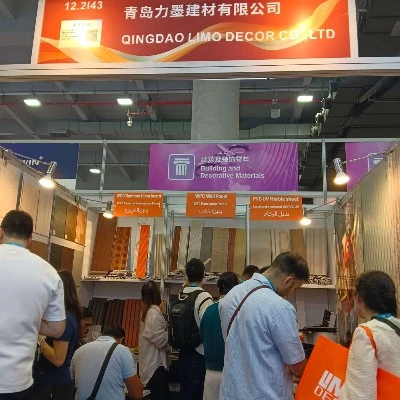
From sheet goods to wall systems
Walking the building and decorative materials section, the most visible change was not a finish but a format. Fewer suppliers stacked loose boards; more built full-height wall mock-ups with aluminium profiles, concealed clips, end caps and corner trims already fitted. The pitch has moved from "here is our board" to "here is a wall one installer can finish in a morning". That shift matters for overseas buyers, because labour cost, not material cost, now decides whether a project stays on schedule. Panels that arrive pre-finished, pre-grooved and colour-matched remove an entire step from the job site. Suppliers who could not show a system were asked, politely, what the panel was actually for.
Wood veneer: engineered realism wins
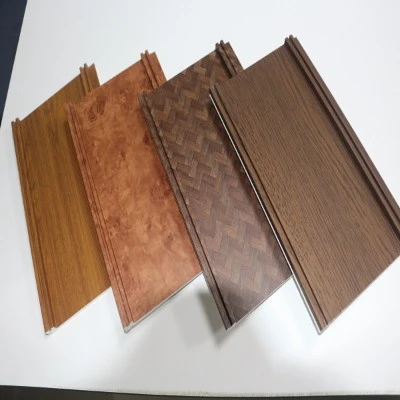
Wood veneer remains the premium line, and the engineering behind it has become the sales argument. Suppliers showed 0.2mm to 0.6mm veneers pressed onto MDF and plywood, with grain sequences booked and matched so adjacent panels read as one continuous surface. Synchronised embossing, where the texture follows the real grain, closed much of the gap between veneer and laminate at half the price. Open-pore and brushed finishes dominated over high-build lacquer looks.
Buyers from Germany, the Netherlands and the Gulf asked the same three questions: fire classification of the substrate, formaldehyde grade, and whether the topcoat survives a coin-scratch test. Suppliers who pre-finished panels under UV coating in the factory, rather than leaving site lacquering to the buyer, held the clearest advantage. Chain-of-custody paperwork for FSC-certified stock was displayed as prominently as the samples themselves. Price for the same species and thickness varied threefold, driven by veneer grade, backing board and coating rather than timber alone.
UV board: gloss retreats, matte advances
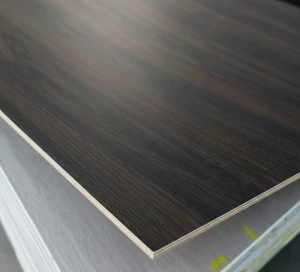
Five years ago UV board meant mirror gloss. At this edition the gloss racks sat at the back. Super-matte, soft-touch and fine-texture surfaces drew the crowds, tracking European and North American interiors toward quiet, fingerprint-resistant finishes. Suppliers demonstrated anti-fingerprint coatings, stain resistance against coffee and marker, and scratch tests with steel wool.
Edges were the real differentiator: seamless laser edge banding against visible glue lines decided specification on kitchen and wardrobe work. Colour consistency between production batches, the defect that ruins a completed project, was addressed with batch coding and pre-packed matched sets. Several factories now quote UV board as a programme for cabinetry, wardrobe interiors and feature walls rather than as a standalone sheet. Decorative printing has narrowed the gap with veneer, but buyers in this hall still paid for the real thing where the eye meets the material.
WPC grilles: the fastest-moving wall element
WPC grilles were the busiest category in the decorative section. Co-extruded louvre profiles in oak, walnut, charcoal and cream, with hollow chambers that keep weight down, appeared both as interior feature walls and as exterior facade screens. The specification conversation has shifted to durability: UV stabilisers and anti-ageing additives for sun exposure, colour-fastness testing, and moisture and termite resistance for coastal projects.
Middle East buyers pressed on heat stability and thermal expansion; North American buyers asked about DIY-friendly rail systems and packaging that survives parcel shipping. Installation speed was the recurring demonstration - clip-on rails and pre-assembled corner returns that let two people cover a wall in an afternoon without wet trades. Suppliers offering matching ceiling and facade profiles in the same finish wrote more enquiries than those selling a single louvre.
The paperwork is the product
Among established buyers, compliance decided shortlists before price. Fire test reports to EN 13501, formaldehyde declarations under CARB Phase 2 or EPA TSCA Title VI, low-VOC documentation and, increasingly, environmental product declarations were requested at the booth rather than after sampling. Suppliers with those files printed and indexed converted enquiries on the spot; those promising to email later lost the follow-up. Sample turnaround and mixed-container flexibility ran a close second, especially from buyers consolidating veneer, UV board and WPC from a single supplier to cut freight and inspection costs. Certification cost is now quoted openly into the unit price, and buyers accept it when the file is complete.
What to watch next season
Three tensions will shape the coming two seasons. Colour matching across material types is still imperfect, so programmes mixing veneer, UV board and WPC carry real risk. PVC alternatives continue to undercut WPC on price in several markets. And freight and tariff uncertainty keeps buyers ordering smaller, more frequent lots. For panel makers leaving Guangzhou, the verdict was blunt: the finish gets you noticed, the documentation gets you the order, and the installation system gets you the repeat. The next test arrives at the spring session, when buyers return with specification sheets rather than curiosity.